What is Simulation or Computer modeling in ICT

Modelling Applications using ICT

What is Modelling?

Computers can be used to simulate different scenarios to work out all of the possible outcomes. This is called 'modelling'.

What is a computer model/simulation?

  1. Simulations aim to mimic (copy) real life systems in order to see the outcomes of different scenarios.
  2. Another name for a computer simulation that mimics real life situations is a 'computer model'.


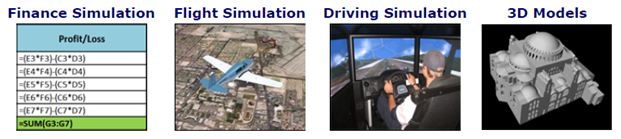
Computer simulations can be created for a range of applications including:


Advantages of using computer models/simulations
  1. Cheaper
  2. Safer
  3. Saves Time
  4. Greater Range of Situations

Disadvantages of using computer models/simulations
  1. Accuracy
  2. Initial Expense
  3. Programmer Error
  
Examples of computer modelling include:
  1. Flight simulators to help train aircraft pilots
  2. 3D models of buildings and products to simulate how designs will look when built
  3. Spreadsheet models to simulate profit/loss based on different levels of income.
  4. Driving Simulation for entertainment, training and crash testing.

What is Measurement Applications or Data Logging using ICT

Measurement Applications (Data Logging) using ICT

What is Data Logging?

Computers are sometimes used alongside sensors to measure quantities such as pressure, temperature, radiation etc. This is known as 'data logging'.

What are sensors used for?


  1. Sensors are used to automatically detect and measure physical quantities.
  2. If the sensor is connected to a computer, the computer can read the data coming from the sensor and log it at preset time intervals (hourly for example). This is sometimes called 'data logging'.
  3. This allows us to see changes in the quantities (temperature increasing or decreasing for example)


Why we use a computer to measure sensor data instead of a person?

Computers are much better at reading and measuring quantity data taken from sensors for the following reasons:
More reliable  : Computers will not forget to take the readings.
Accuracy : The computer will read the data more accurately than a person.
Response time : Computers can react much quicker to data received. For example, if a patient's heart rate drops to critical levels an alarm could be sounded automatically.
Work longer : Computers can read data all day, every day without getting bored or tired.
Frequency of readings : Computers can read the data more frequently than humans can (1000's of times a second if needed).
Automatic Readings : No need for a human to be present. This frees people up to carry out other tasks.
Safer : Some environments can be lethal to humans. For example monitoring radiation levels in a damaged power station.

Examples of Computer Measurement Applications

  1. Scientific Experiments
  2. Electronic Timing
  3. Environmental Monitoring


Examples of Computer Measurement Applications

Scientific Experiments
Data logging can be setup to automatically to monitor and record data generated by scientific experiments.
Water Temperature Example: Imagine you are conducting an experiment that records the temperature of water as it transforms from solid ice into hot steam. We would need to use the following:
  1. Thermostat to measure the temperature of the water
  2. ADC to convert the analogue temperature data into digital
  3. Computer to receive and log the digital temperature data
  4. Software to analyze the received data

Electronic Timing
Computerized data logging can be used to accurately to measure time.
Olympic 100 Meters Race Example: Sound Sensor to record when the race is started
  1. Infrared Sensor to record when the athlete crosses the finish line
  2. ADC to convert the analogue data from the sensors into digital
  3. Computer and Software to receive and log the digital data and calculate race time.

Environmental Monitoring
Environmental monitoring is where data is collected to be used for purposes such as:
  • Weather forecasting
  • Water quality in rivers and streams
  • Levels of air pollution

Weather Forecasting Example: Weather stations contain lots of sensors which are used to gather a variety of different data.

  1. Thermometer to measure temperatures
  2. Humidity Sensor to measure the amount of water in the air
  3. Barometer to measure air pressure
  4. Anemometer to measure wind speed
  5. Rain Gauge to measure the amount of rain fall over a certain period.

What is data handling applications using ICT

Data Handling Applications using ICT

What is Data Handling?


Data Handling is basically where data is input and stored on a computer. The data is then processed in some way to turn it into useful information. This information can then be output and used.


Why use a computer to handle data?

Computers are much better at handling data than paper based methods (like files of paper) for many reasons including:

Searching Computers can find stored data very quickly
Editing Computer data can be edited (changed) very easily
Backed up Copies of data can be made very easily
Security Passwords can be applied to computers
Sorting Data can be organized in different orders quickly
Transported Computer data can be moved via flash memory
Output Data can be printed out easily

Examples of Data that could be Stored on a Computer

  1. Survey Results
  2. Address Lists
  3. Shop Records
  4. Clubs and Society Records
  5. School Reports
  6. School Library Records